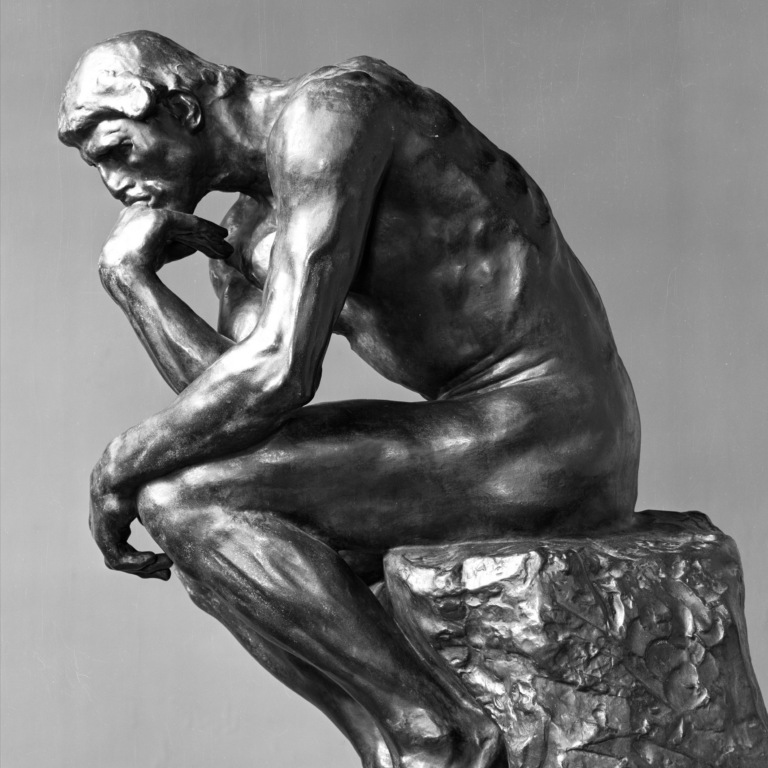
For years, people viewed professional development as the process of acquiring new knowledge: learn a framework, gain expertise, accumulate information. But the advent of AI is shifting that notion. Increasingly, high performance will be less about who “has answers,” and more about understanding how thinking works.
I’ve noticed this in my own interactions with AI. I rarely use AI to create products or provide information. Instead, I employ it as a thought partner, in the same way that I might with a colleague, editor, reviewer, or by consulting a dictionary or other reference material. Therefore, I am not simply outsourcing my thinking but am distributing it.
Privately, I parse my thinking into three thematic zones. The first is my internal thinking (e.g. personal beliefs, intuitions, observations, and critiques). The second is collaborative cognition (e.g. argumentation and theory building). Finally, there is externalized thinking (e.g. external critique, computation, brainstorming). This helps me decide when to generate ideas on my own, when to seek help, and what type of assistance might be most useful.
Thinking Has Its Own Grammar
One useful distinction I’ve been considering is the idea that thinking consists of verbs and nouns. The process of thinking—its operations—are the verbs. Operations are the actions the mind performs. Here is a list of several types of thinking processes:
structuring (organizing ideas into frameworks)
predicting (extending patterns into the future)
simulating (imagining alternatives)
translating (mapping insight from one domain into another)
constraint testing (determining limits)
Most of us engage in these processes naturally. But in an AI-rich environment, these operations become more explicit. We begin to see not only what we think, but how we think. We can prompt our AI tools to emphasize modes of thinking such as asking it to test the limits of our ideas or by offering our own predictive thinking.
This matters because different kinds of cognition are better distributed differently. For example, I find it useful for “structuring.” When I am working on a new framework, I might prompt my AI partner to identity hidden assumptions.
By contrast, AI is a poorer fit for thinking that requires ambiguity, time, and lived experience. For example, the perspective that comes out of a period of grief, the conviction that results from wrestling with an idea, or the caution association with moral uncertainty. None of these benefits from the speed or access to information that AI provides.
Thinking Also Produces Nouns
If operations are the verbs of thinking, then the products of thinking are the nouns. Although we broadly call the outputs of cognition “ideas,” they actually fall into distinct categories: models, narratives, hypotheses, and analogies, to name a few.
One risk in the AI era is that it is easy to become enamored with coherence. A beautifully structured AI argument is not necessarily a true one. A fluent explanation is not always wise. We need to become better evaluators of cognitive products, not merely consumers of them.
This is where metacognition enters the picture. Thinking about thinking is going to be among the critical 21st century skills.
The people who thrive in the next decade may be those who can:
notice their own cognitive habits (including a recognition of their own strengths and limitations)
discern which thinking tasks to collaboratize and/or externalize
preserve deep human capacities like judgment, intuition, ethics, and relational sensitivity
strategically shape the partnership between human and artificial cognition
In other words, they will not merely use AI. They will understand the architecture of thinking itself.
Conclusion
Over the next few days, try a simple exercise: when you are solving a problem or coming up with a new idea, pause occasionally and ask yourself: “What kind of thinking am I doing right now?”
Are you generating? Compressing? Simulating? Testing constraints? Translating?
Most people focus exclusively on the content of thought or on its outputs. Increasingly, professional excellence may depend on becoming aware of the processes beneath it. The AI era might not simply reward intelligence. It might reward those people who can see intelligence happening in real time.
Dr. Robert Biswas-Diener is passionate about leaving the research laboratory and working in the field. His studies have taken him to such far-flung places as Greenland, India, Kenya, and Israel. He is a leading authority on strengths, culture, courage, and happiness and is known for his pioneering work in the application of positive psychology to coaching.
Robert has authored more than 75 peer-reviewed academic articles and chapters, four of which are “citation classics” (cited more than 1,000 times each). Dr. Biswas-Diener has authored nine books, including the 2007 PROSE Award winner, Happiness, the New York Times Best Seller, The Upside of Your Dark Side, the 2023 coaching book Positive Provocation, and Radical Listening, in 2025.
Thinkers50 named Robert to be among the 50 most influential executive coaches in the world.